
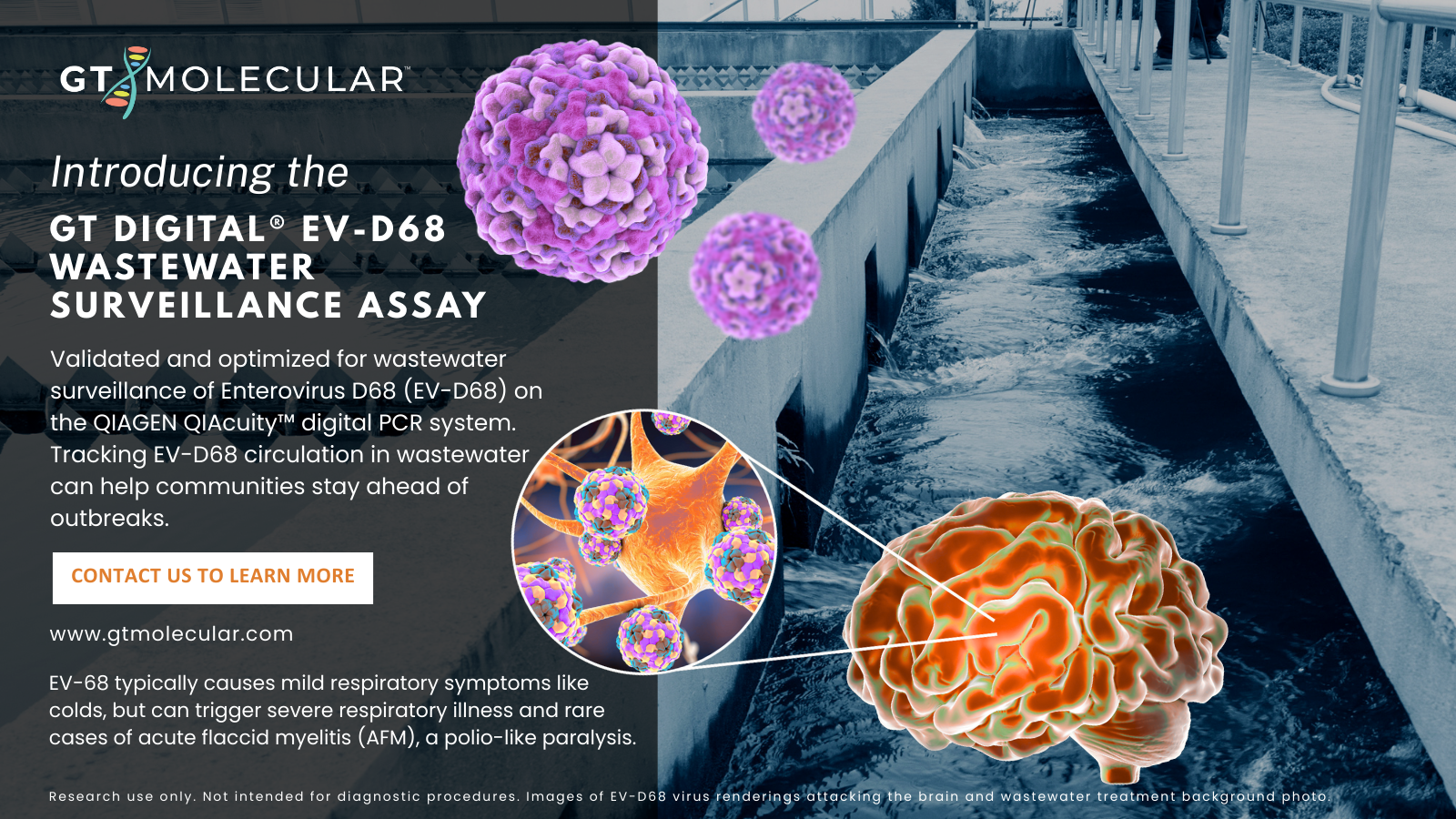
Enterovirus-68: Why is it a Public Health Risk? [cite: 1]
By Layla Katiraee, GT Molecular [cite: 1]
Enterovirus D68 (EV-D68) is a respiratory virus that has gained increasing attention from public health experts due to its potential to cause severe illness, especially in at-risk children[cite: 2]. As outbreaks continue to emerge, wastewater-based epidemiology (WBE) is proving to be a powerful tool for early detection and public health response[cite: 3].
What Is Enterovirus D68? [cite: 4]
EV-D68 is a non-polio enterovirus that often leads to mild symptoms such as a runny nose, sneezing, and coughing[cite: 5]. However, children—particularly those with asthma or other respiratory conditions—are at higher risk for complications[cite: 6].
In 2014, EV-D68 gained national attention due to its association with acute flaccid myelitis (AFM)[cite: 7]. This rare neurological condition leads to limb weakness and the loss of muscle tone and reflexes[cite: 8].
Most AFM cases occur in children, and currently, there is no vaccine available against EV-D68[cite: 9].
Wastewater Surveillance as a Public Health Tool [cite: 10]
EV-D68 outbreaks tend to follow a biennial pattern, with spikes observed in 2014, 2016, 2018, 2022, and 2024[cite: 11]. These outbreaks have coincided with increases in AFM cases, leading experts to anticipate that 2026 may be another year with a spike in cases[cite: 11, 12].
Key Advantages of WBE: [cite: 13]
- Early Detection: Viral RNA can be detected in wastewater before clinical cases are reported[cite: 14].
- Community-Level Monitoring: Data captures both symptomatic and asymptomatic individuals[cite: 15].
- Cost-Effective: Wastewater sampling is more scalable and efficient than individual testing[cite: 16].
Proven Results
In California, researchers tracked EV-D68 RNA in wastewater solids over 26 months and found that viral concentrations spiked between July and December 2022, aligning with confirmed clinical cases[cite: 17, 18]. Similar studies in Israel and Colorado have demonstrated strong correlations between wastewater data and clinical surveillance[cite: 19]. Detailed data is available via the CDC and MDPI[cite: 20].
Strengthening Public Health Preparedness [cite: 21]
Integrating wastewater surveillance into routine monitoring enhances outbreak preparedness and helps health authorities allocate resources effectively[cite: 22, 23]. At GT Molecular, we are committed to advancing the molecular tools that empower communities to stay ahead of outbreaks and protect vulnerable populations.
Enterovirus-68: Why is it a Public Health Risk?
[cite_start]By Layla Katiraee, GT Molecular [cite: 1]
[cite_start]Enterovirus D68 (EV-D68) is a respiratory virus that has gained increasing attention from public health experts due to its potential to cause severe illness, especially in at-risk children[cite: 2]. [cite_start]As outbreaks continue to emerge, wastewater-based epidemiology (WBE) is proving to be a powerful tool for early detection and public health response[cite: 3].
What Is Enterovirus D68?
[cite_start]EV-D68 is a non-polio enterovirus that often leads to mild symptoms such as a runny nose, sneezing, and coughing[cite: 5]. [cite_start]However, children with asthma or other respiratory conditions are at a significantly higher risk for complications[cite: 6].
[cite_start][cite_start]In 2014, EV-D68 gained national attention due to its association with acute flaccid myelitis (AFM)[cite: 7]. [cite_start]This rare neurological condition leads to limb weakness and the loss of muscle tone and reflexes[cite: 8].
Most AFM cases occur in children, and currently, there is no vaccine available against EV-D68[cite: 9].
Wastewater Surveillance: A Key Public Health Tool
[cite_start]EV-D68 outbreaks tend to follow a biennial (every two years) pattern, with notable spikes in 2014, 2016, 2018, 2022, and 2024[cite: 11]. [cite_start]Because of this trend, experts anticipate that 2026 may be another year with a spike in cases[cite: 12].
Key Advantages of WBE:
-
[cite_start]
- Early Detection: Viral RNA can be detected in wastewater before clinical cases are reported, allowing for proactive responses[cite: 14]. [cite_start]
- Community-Level Monitoring: Data is captured from both symptomatic and asymptomatic individuals[cite: 15]. [cite_start]
- Cost-Effective: Wastewater sampling is more scalable and efficient than individual testing[cite: 16].
Proven Results in the Field
[cite_start]Research in California tracked EV-D68 RNA in wastewater over 26 months and found that viral concentrations spiked between July and December 2022, aligning with confirmed clinical cases and AFM diagnoses[cite: 17, 18]. [cite_start]Similar success has been seen in Colorado and Israel, reinforcing the value of this monitoring[cite: 19]. [cite_start]Detailed data on these trends can be found via the CDC and MDPI[cite: 20].
Strengthening Public Health Preparedness
[cite_start]Integrating wastewater surveillance into routine monitoring can enhance outbreak preparedness and help health authorities allocate resources effectively[cite: 22, 23]. [cite_start]At GT Molecular, we are committed to advancing the molecular tools that empower communities to stay ahead of outbreaks and protect vulnerable populations[cite: 24, 25].